The past week was filled with the same mix of calls regarding wildlife - calls from people who wanted to help the animal they'd encountered, and calls from people who could not have cared less if the animal in their yard was killed... they just wanted it gone, out of their life, as if it were rubbish. This next story, though, was the clincher.
As it goes, it was Wednesday morning at Patrick Henry Middle School in Granada Hills, CA. A little girl, maybe 11 years old, watched as a gang of boys, a couple years older than she, pulled down a nest of house finches and began stomping on them, crushing and killing them, swatting at the parents who were desperately trying to save their babies. One of the nestlings managed to hop to the side where this brave little girl was able to race in and rescue it. She ran to the school's office for help. The baby bird was transferred to one of our colleagues, Valley Wildlife Care (an exceptional rehabilitation program in the West Valley). The nestling finch is in stable condition though it suffered substantial injuries in the attack.
Reading about this on their Facebook page, I contacted Brenda, Founder and Executive Director of VWC to see what, if anything, could be done about this latest incident of animal cruelty by minors. With her blessing, WildRescue issued a press release and contacted authorities.
It turns out that the Federal agency, US Fish & Wildlife Service, that normally investigates crimes involving native wild bird is unable to do so because minors are involved (Who knew?). That's okay - because apparently animal cruelty penalties are much more severe.
At this point in time, the Los Angeles Animal Services Animal Cruelty Task Force is taking the lead on investigating the heinous crime. We are supporting ACTF in any way we can, hoping the boys are swiftly and severely punished and that their parents are, too, held accountable.
We are also planning to honor the little girl for her valiant efforts and to counter the inhumanity she experienced. She witnessed murder - and, she took action. She put herself on the line to save a tiny life - something few adults would do. This must but embraced. We, along with Valley Wildlife Care, will be presenting her with an award in recognition of her compassion and bravery. If you have any thoughts, ideas, or want to be involved, let me know.
So, all of this has lead me to, once again, question, why. Why are we seeing an increase in the frequency and intensity of acts of animal cruelty by minors? Why does it seem like more and more people view wildlife and nature as something of an annoyance that should simply be disposed of? Perhaps it is something called Nature Deficit. I'll end this solemn and sobering Wild Byte with a recommendation for a book, Last Child in the Woods, which explores the phenomenon. I just ordered myself a copy.
Thank you, once again, for supporting WildRescue!
Sunday, May 1, 2011
Sunday, April 24, 2011
24th
Our Worldwide Fishing Line Cleanup Day (for Earth Day) was quite a success, especially since it was only 3 weeks in the making. Next year we'll start planning well in advance. Please be sure to check out the gallery and map at Picasa to see what was picked up and from where. More pics are being added as they come in.
It's been a very busy couple of weeks and the season is just getting underway. What is clearly evident is there are not enough helping hands to see to all the sick, injured, and orphaned wild animals that are reported... read the full story on our blog, HERE.
It's been a very busy couple of weeks and the season is just getting underway. What is clearly evident is there are not enough helping hands to see to all the sick, injured, and orphaned wild animals that are reported... read the full story on our blog, HERE.

Sunday, April 17, 2011
17th
In three days, on Wednesday night, April 20th - the anniversary of the Deepwater Horizon explosion in the Gulf of Mexico, a very special film will air on HBO, Saving Pelican 895.
This award winning documentary by filmmaker Irene Taylor Brodsky, chronicles the journey of one young pelican - from when he was first rescued, covered in oil, through his rehabilitation, to his subsequent return to the wild. You'll get a first-hand look at the intense process of caring for oiled wildlife and how many people are involved - and you just might recognize one or two of them! Read more and get sneak peek on our blog.
Our Earth Day event, Worldwide Fishing Line Cleanup, is shaping up nicely! We've received pledges from people in the United Kingdom and Australia!!! Should be fun. If you have not picked a spot to canvas, please do, It can be anywhere and any time on the 23rd. Just emailearthday@wildrescue.org. Here's a great news article about the event.
Lastly, we received an email this week from our friend, the Turkey Whisperer. He wanted to share a recent photo of Pinky with us. Handsome! If you don't know the story of Pinky, it's pretty incredible. Please check out the story on our blog.
Okay, that's a wrap.
This award winning documentary by filmmaker Irene Taylor Brodsky, chronicles the journey of one young pelican - from when he was first rescued, covered in oil, through his rehabilitation, to his subsequent return to the wild. You'll get a first-hand look at the intense process of caring for oiled wildlife and how many people are involved - and you just might recognize one or two of them! Read more and get sneak peek on our blog.
Our Earth Day event, Worldwide Fishing Line Cleanup, is shaping up nicely! We've received pledges from people in the United Kingdom and Australia!!! Should be fun. If you have not picked a spot to canvas, please do, It can be anywhere and any time on the 23rd. Just emailearthday@wildrescue.org. Here's a great news article about the event.
Lastly, we received an email this week from our friend, the Turkey Whisperer. He wanted to share a recent photo of Pinky with us. Handsome! If you don't know the story of Pinky, it's pretty incredible. Please check out the story on our blog.
Okay, that's a wrap.
Wednesday, April 13, 2011
13th
Spring is upon us... and with the warming days come wild babies. This is just a reminder of what to look out for and what you should do:
- A baby bird on the ground that is feathered - alert - wants to get away from you - can hop and perch - both wings look the same:
1) Should NOT be removed unless parents are confirmed dead.
2) Should NOT be placed back in nest - it will only risk falling again - it wants to be and needs to be out of the nest!
3) Can be placed on LOW branches within a few yards from where it was first observed.
4) Give the baby time and space to grow up - turn off automatic sprinklers, put off yard cleanup, keep cats and dogs away from the area for a few days at least.
Baby birds that appear lethargic, 'sad looking', sunken eyes, cold to the touch, fluffed up - require immediate attention!
1) With clean dry hands a baby bird can be placed into clean box or plastic tub lined with a non-frayed towel (not terry cloth). Container should not be too large - the sides should not be more than a few inches from the bird's body, if possible. The towel can be shaped into a cup to help support the bird, like a nest.
2) Supply a heat source. Here are some ways to warm the baby:
a) Heating pad on Low or Medium set UNDER or AROUND only a PORTION of the container - must get the ambient heat surrounding the bird to about 80 - 85 degrees. MUST MONITOR FOR OVERHEATING!
b) Vessel of hot/warm water WRAPPED in a DISH TOWEL. Must NOT come into direct contact with bird but set to the side of the towel 'cup' or underneath 'cup'. Warmth will last about 20 - 30 minutes. As the water cools it must be removed as it will also cool down the baby.
c) Dry rice (or other dry grains/legumes) - microwaved (NO WATER) for about 1 minute - tossed and turned and microwaved for another minute or so until it is quite warm to the touch - almost hot. Place in cotton sock or pillowcase, tied close. Place near or under towel 'cup'.
2) Call for help - 1-866-WILD-911 or local (Bay Area, Monterey, Los Angeles) page 831-429-2323.
- A baby bird on the ground that is feathered - alert - wants to get away from you - can hop and perch - both wings look the same:
1) Should NOT be removed unless parents are confirmed dead.
2) Should NOT be placed back in nest - it will only risk falling again - it wants to be and needs to be out of the nest!
3) Can be placed on LOW branches within a few yards from where it was first observed.
4) Give the baby time and space to grow up - turn off automatic sprinklers, put off yard cleanup, keep cats and dogs away from the area for a few days at least.
Baby birds that appear lethargic, 'sad looking', sunken eyes, cold to the touch, fluffed up - require immediate attention!
1) With clean dry hands a baby bird can be placed into clean box or plastic tub lined with a non-frayed towel (not terry cloth). Container should not be too large - the sides should not be more than a few inches from the bird's body, if possible. The towel can be shaped into a cup to help support the bird, like a nest.
2) Supply a heat source. Here are some ways to warm the baby:
a) Heating pad on Low or Medium set UNDER or AROUND only a PORTION of the container - must get the ambient heat surrounding the bird to about 80 - 85 degrees. MUST MONITOR FOR OVERHEATING!
b) Vessel of hot/warm water WRAPPED in a DISH TOWEL. Must NOT come into direct contact with bird but set to the side of the towel 'cup' or underneath 'cup'. Warmth will last about 20 - 30 minutes. As the water cools it must be removed as it will also cool down the baby.
c) Dry rice (or other dry grains/legumes) - microwaved (NO WATER) for about 1 minute - tossed and turned and microwaved for another minute or so until it is quite warm to the touch - almost hot. Place in cotton sock or pillowcase, tied close. Place near or under towel 'cup'.
2) Call for help - 1-866-WILD-911 or local (Bay Area, Monterey, Los Angeles) page 831-429-2323.
Sunday, April 10, 2011
10th
Today, Sunday, we will be installing two of our barn owl boxes on two residences - one in Gilroy, the other in Morgan Hill. Very cool!
Highlights from this week include an opossum found sleeping in a whicker basket, and the freeing of yet another inadvertently trapped skunk. Read about these stories and more on our BLOG.
Now for the big news:
Inspired by one of our volunteers, WildRescue is coordinating an Earth Day event for April 23rd.
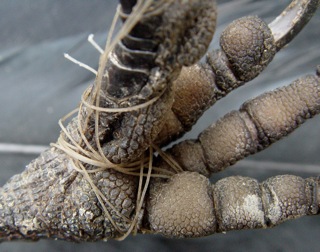
Even in a big city you'll find manmade ponds or reservoirs where people fish. Where people fish, there will be loose, abandoned line. Abandoned line kills! Pictured here is a raven's foot, tangled in line. He was snagged on a branch, high up in a cypress tree.
Highlights from this week include an opossum found sleeping in a whicker basket, and the freeing of yet another inadvertently trapped skunk. Read about these stories and more on our BLOG.
Now for the big news:
Inspired by one of our volunteers, WildRescue is coordinating an Earth Day event for April 23rd.
Worldwide Fishing Line Cleanup
You, too, can take part - anytime and anywhere on the 23rd - just pick a spot.
Seriously. Just pick a location near you - the shore of any ocean, lake, river or stream. Then, let us know (email) so we can add your efforts to the Map (check it out).Even in a big city you'll find manmade ponds or reservoirs where people fish. Where people fish, there will be loose, abandoned line. Abandoned line kills! Pictured here is a raven's foot, tangled in line. He was snagged on a branch, high up in a cypress tree.
Please help make a difference, won't you?
Sunday, April 3, 2011
3rd
You know those skinny-necked Yoplait yogurt containers? Well, what happens - way too often, is that wild animals, like skunks, get their little heads stuck in them. It may sound a bit funny, but it must be terrifying for the animal and surely kills many that go unnoticed.
Thanks to the fellow in Aptos, CA, who called us on Friday about a skunk stuck in his garbage container, and many Thanks to Deanna, a member of our Wildlife Search & Rescue Team, for responding to the call and taking the time to see that it was not simply a skunk stuck in a trash can, but in a yogurt cup, as well. The poor creature had been in this predicament for over 8 hours before WildRescue was contacted.
Deanna smartly and carefully tipped the can and covered the animal with a large heavy blanket to remove the cup from its face. Once its head was free she stepped back quickly, standing very still. There was a moment of direct eye contact, a sigh of relief from both sides, i am sure, and the skunk romped off into the woods. See pics and read more onWildRescue's blog.
Just like those awful plastic six-pack thingamajigs, try to avoid purchasing such containers or slice them up before tossing them in the RECYCLING bin. Above all - see that no wild animals have access to your garbage.
Stay tuned for news on upcoming beach cleanups where you'll be invited to meet up with other WildRescue volunteers and supporters for a day at the beach, picking up trash.
Thanks to the fellow in Aptos, CA, who called us on Friday about a skunk stuck in his garbage container, and many Thanks to Deanna, a member of our Wildlife Search & Rescue Team, for responding to the call and taking the time to see that it was not simply a skunk stuck in a trash can, but in a yogurt cup, as well. The poor creature had been in this predicament for over 8 hours before WildRescue was contacted.
Deanna smartly and carefully tipped the can and covered the animal with a large heavy blanket to remove the cup from its face. Once its head was free she stepped back quickly, standing very still. There was a moment of direct eye contact, a sigh of relief from both sides, i am sure, and the skunk romped off into the woods. See pics and read more onWildRescue's blog.
Just like those awful plastic six-pack thingamajigs, try to avoid purchasing such containers or slice them up before tossing them in the RECYCLING bin. Above all - see that no wild animals have access to your garbage.
Stay tuned for news on upcoming beach cleanups where you'll be invited to meet up with other WildRescue volunteers and supporters for a day at the beach, picking up trash.
Sunday, March 27, 2011
27th
We've had quite a few wildlife rescue calls in the last month where skunks and opossums have been inadvertently trapped by people using 'humane' traps to catch stray cats. We instructed the callers on how to let the poor animals free, or responded to the call and carefully removed the terrified animal.
Here's a tip for cat 'trappers':
Humane traps intended to catch domestic cats should be set during daylight hours only. From sunrise to sunset. This will cut down on the number of wild animals caught and killed.
Speaking of trapping - did you know that it is illegal in California for anyone to set a trap for a wild animal within 150 yards of another's residence without that resident's written permission?
Here's a tip for cat 'trappers':
Humane traps intended to catch domestic cats should be set during daylight hours only. From sunrise to sunset. This will cut down on the number of wild animals caught and killed.
Speaking of trapping - did you know that it is illegal in California for anyone to set a trap for a wild animal within 150 yards of another's residence without that resident's written permission?
Subscribe to:
Posts (Atom)